Editorial / technical guide
This page is educational content, not a documented customer project.
Anti-Fog Film: Improving Retail Efficiency in Supermarkets
Technical Abstract
Anti-Fog Film for Freezer Doors: Energy Savings & Visibility for Grocers For supermarket and grocery store owners, applying anti-fog film to freezer and cooler doors directly reduces condensation and ..
- Anti-fog film reduces condensation on freezer doors by using a hydrophilic coating to spread moisture evenly, eliminating fogging.
- It cuts energy use by allowing reduction or elimination of anti-sweat heaters, saving on electricity and refrigeration load.
- Benefits include improved product visibility for increased sales, reduced slip hazards, and extended equipment life.
- Implementation requires professional installation, commercial-grade film selection, and pilot testing for optimal results.
Key Technical Chapters
Anti-Fog Film for Freezer Doors: Energy Savings & Visibility for Grocers
For supermarket and grocery store owners, applying anti-fog film to freezer and cooler doors directly reduces condensation and fogging, which dramatically cuts the reliance on energy-intensive anti-sweat heaters. This leads to immediate energy savings, lowers operational costs, and provides uninterrupted product visibility to boost sales.
Looking for commercial window tint installers?
The Problem: Condensation, Heaters, and Hidden Products
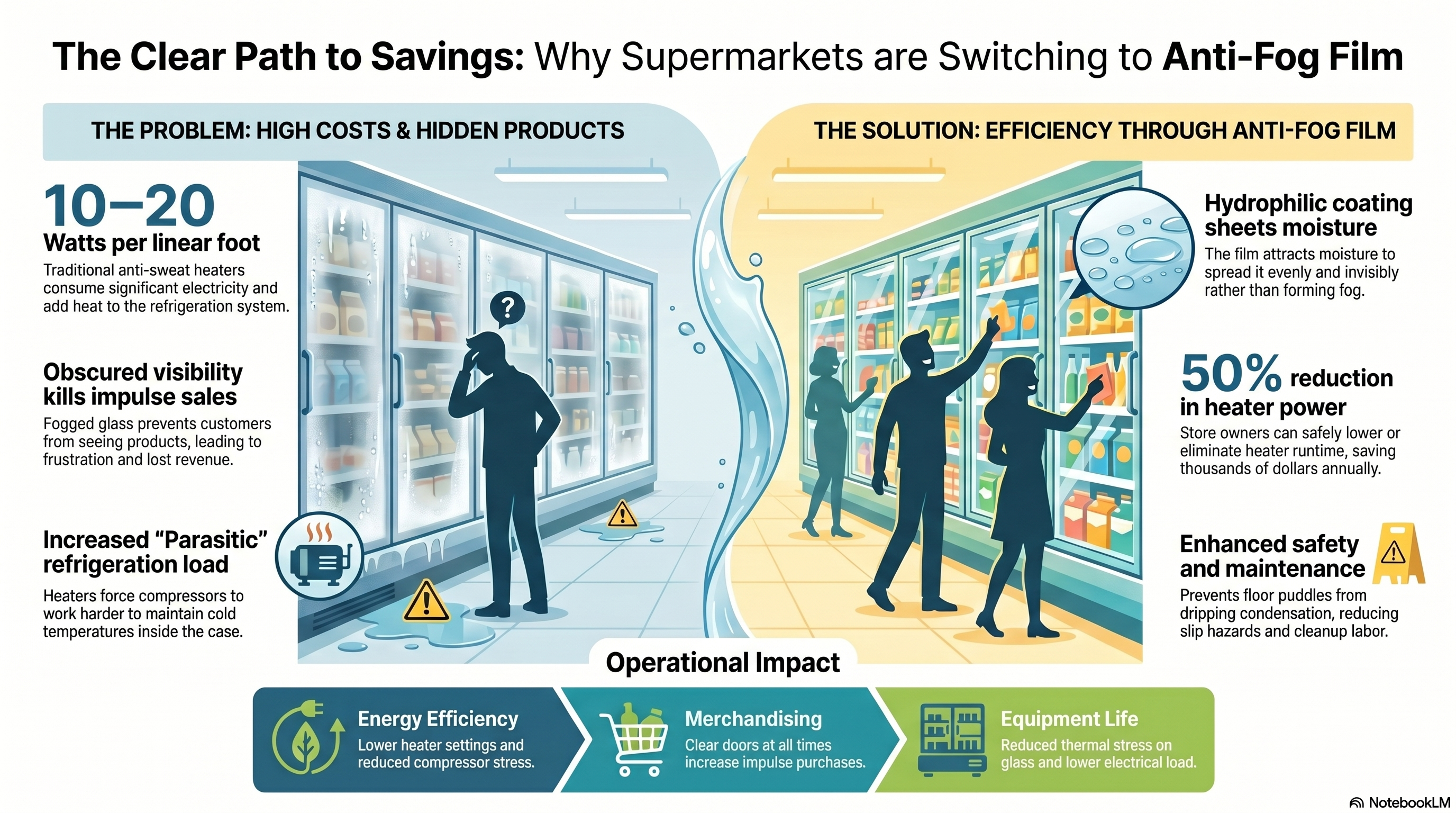
Traditional freezer doors face a constant battle with humidity. When warm, moist store air meets the cold glass surface, condensation and fog form, obscuring products. To combat this, doors are equipped with anti-sweat heaters—electrical resistance wires that warm the glass edge or frame to prevent condensation. These heaters run continuously, consuming significant electricity and adding to the refrigeration load, making them a major operational expense.
How Anti-Fog Film Provides the Solution
Anti-fog film is a transparent, durable polyester layer applied to the interior glass surface of the door. Its hydrophilic (water-attracting) coating causes moisture to sheet evenly across the surface in a clear, thin layer instead of beading into disruptive droplets or fog. This maintains a consistently clear view without the need for primary heat-based prevention.
Direct Energy Savings from Reduced Heater Use
By effectively managing condensation at the glass surface, anti-fog film allows for the reduction or complete elimination of anti-sweat heater runtime. The energy savings are substantial and calculable.
- Heater Power Reduction: Facility managers can safely lower heater settings by 50% or more, or use intermittent controls, as the film handles the primary anti-fogging duty.
- Reduced Refrigeration Load: Anti-sweat heaters introduce heat into the refrigerated case, forcing compressors to work harder. Lowering heater use reduces this parasitic load, compounding energy savings.
- Measurable ROI: Savings depend on door count, local energy rates, and heater wattage (typically 10-20 watts per linear foot of door). A medium-sized supermarket can save thousands of dollars annually on energy costs alone.
Operational Benefits Beyond Energy
The advantages extend far beyond the utility bill, impacting core retail operations.
| Benefit | Impact for Grocery Stores |
|---|---|
| Uninterrupted Product Visibility | Clear doors at all times increase impulse purchases, reduce customer frustration, and enhance merchandising appeal. |
| Improved Maintenance & Safety | Eliminates puddles on the floor from dripping condensation, reducing slip hazards and cleanup labor. |
| Extended Equipment Life | Reduced thermal stress on glass and lower electrical load on door systems can decrease long-term maintenance costs. |
| Sustainability Reporting | Direct energy reduction contributes to corporate sustainability goals and can improve ESG (Environmental, Social, and Governance) scores. |
Implementation Considerations for Store Owners
To maximize results, a strategic approach is recommended.
- Professional Installation: For longevity and clarity, films should be installed by certified professionals to ensure a bubble-free, sealed application.
- Film Selection: Choose a commercial-grade, scratch-resistant film designed for low-temperature environments and high-frequency cleaning.
- Pilot Program: Test the film on a set of high-traffic doors to validate savings and visibility improvements before a chain-wide rollout.
- System Integration: Work with a qualified technician to properly adjust anti-sweat heater controls in conjunction with film installation to realize full energy savings.
Find Commercial Window Tinting Near You
Browse installers by city — get matched with commercial window film specialists in your area.
Technical FAQ
How does anti-fog film work to prevent condensation on freezer doors?
Anti-fog film is a transparent polyester layer with a hydrophilic coating applied to the interior glass surface. This coating attracts moisture, causing it to sheet evenly across the surface in a thin, clear layer instead of forming disruptive droplets or fog, maintaining visibility without relying primarily on heat-based methods.
What are the energy savings associated with using anti-fog film in supermarkets?
Energy savings come from reducing or eliminating anti-sweat heater use, which typically consumes 10-20 watts per linear foot of door. This allows for heater settings to be lowered by 50% or more, reduces the refrigeration load by decreasing heat introduced into cases, and can save thousands of dollars annually in a medium-sized supermarket, depending on door count and local energy rates.
What should store owners consider when implementing anti-fog film?
Store owners should opt for professional installation to ensure a bubble-free application, select commercial-grade, scratch-resistant film suitable for low temperatures and frequent cleaning, and conduct a pilot program on high-traffic doors to validate savings and visibility improvements before a full rollout.
Ready to optimize your facility?
Review available company information in the directory and prepare a project brief for suppliers.