Editorial / technical guide
This page is educational content, not a documented customer project.
Architectural Mesh vs. Solar Control Film: Façade Performance Review
Technical Abstract
In the pursuit of high-performance, energy-efficient building envelopes, architects and building owners are often presented with two compelling e..
Key Technical Chapters
In the pursuit of high-performance, energy-efficient building envelopes, architects and building owners are often presented with two compelling exterior solar control solutions: architectural metal mesh (solar screens) and high-performance solar control window film. This guide provides a detailed, data-driven comparison of these technologies, analyzing their impact across aesthetics, financial structures, maintenance, and performance, with a specific focus on the 'Passive First' design philosophy.
Looking for commercial window tint installers?
Understanding the 'Passive First' Philosophy
The 'Passive First' approach prioritizes the reduction of a building's energy demands through inherent design and material choices before layering on active mechanical systems. It emphasizes the building envelope as the primary line of defense against solar heat gain, glare, and thermal bridging. Both metal mesh and solar control film are passive technologies, but they integrate with and affect the building system in fundamentally different ways. The optimal choice aligns with project-specific goals for aesthetics, budget lifecycle, and performance metrics.
Comparative Analysis: Architectural Metal Mesh vs. High-Performance Solar Control Film
1. Aesthetic Impact & Design Integration
Architectural Metal Mesh (Solar Screens):
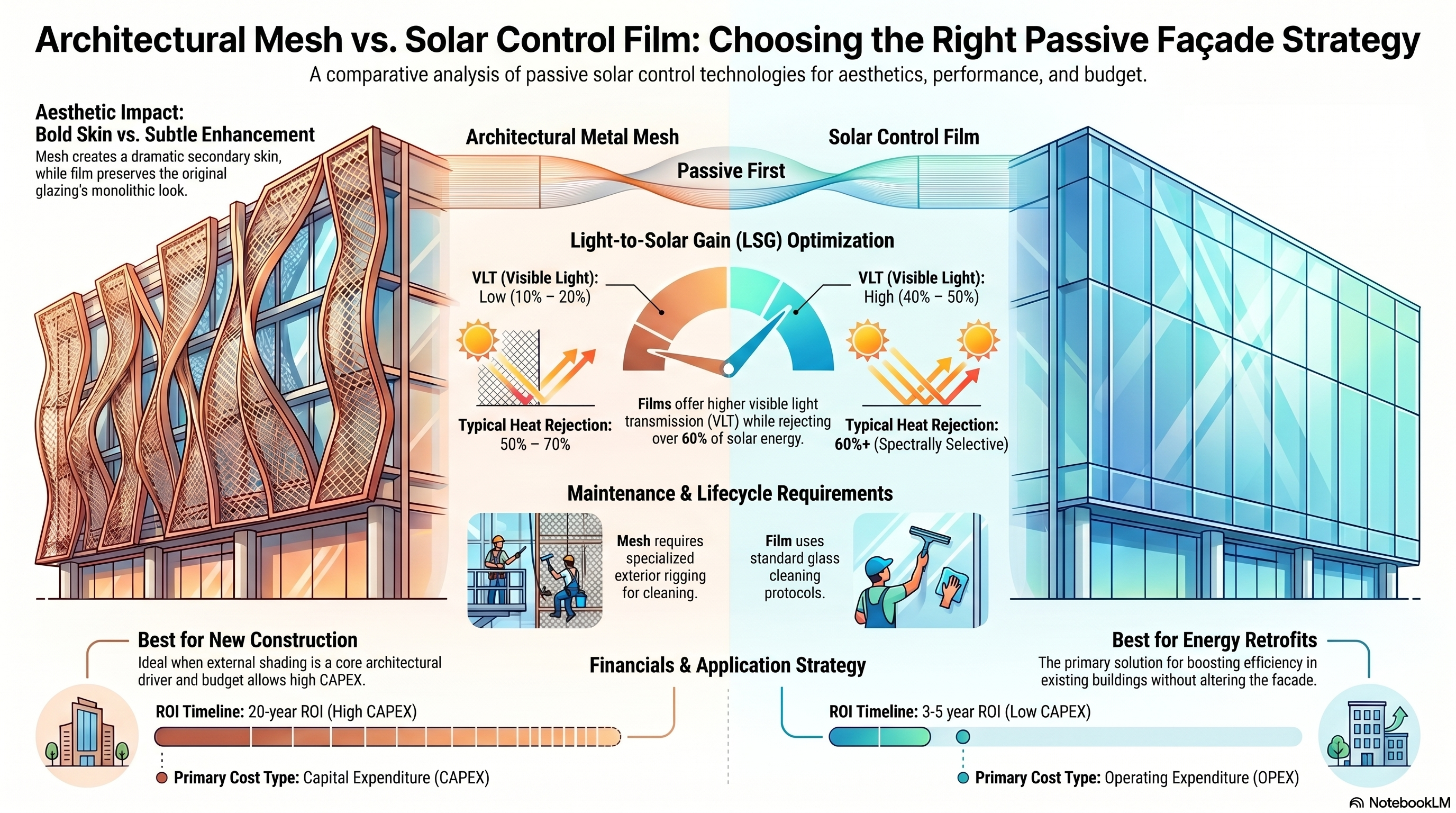
- Dynamic Facade Element: Metal mesh functions as a distinct, often dramatic, secondary skin. It creates depth, texture, and a pronounced modern or industrial aesthetic. The weave density, color (anodized or powder-coated), and profile can be customized, offering significant design flexibility to create a unique architectural statement.
- Visual Transformation: It significantly alters the building's exterior appearance, potentially obscuring the view of the underlying glazing and framing. From the interior, it can create a filtered, screened view to the outside.
- Permanence & Scale: The installation is a permanent, capital-intensive architectural feature, best suited for new construction or major recladding projects where the aesthetic is a core design driver.
High-Performance Solar Control Film:
- Subtle Glazing Enhancement: Window film is applied directly to the interior glass surface (or laminated in-glass). It preserves the architect's original vision of the glazing system, maintaining a clean, monolithic appearance from both the exterior and interior. Tints can range from nearly clear to reflective.
- View Preservation: Modern spectrally selective films offer high levels of solar rejection while maintaining exceptional visible light transmission (VLT), ensuring occupant connection to the outdoors and reducing the need for artificial lighting—a key 'Passive First' benefit.
- Retrofit-Friendly: Its greatest aesthetic advantage in retrofit is the ability to upgrade performance without altering the building's historic or designed facade, a crucial consideration for LEED EBOM or adaptive reuse projects.
2. Financial Structure: CAPEX vs. OPEX
Architectural Metal Mesh (Solar Screens):
- High Initial CAPEX: This is a significant capital expenditure involving custom fabrication, heavy structural support systems (frames, brackets), and complex installation, often requiring cranes and extensive labor. Costs are comparable to other facade cladding systems.
- OPEX Implications: While durable, its primary operational savings come from reduced solar load on HVAC systems. However, it does not address conductive heat gain/loss through the glass itself and may increase wind loading on the building structure.
- Financial Model: The investment is depreciated as a long-term building component. The ROI is calculated over a 20-30 year lifespan, tied directly to energy savings and potential utility incentives.
High-Performance Solar Control Film:
- Lower Initial CAPEX: Installation costs are a fraction of a metal mesh system. It involves no structural modifications and can be installed quickly with minimal disruption to building operations, even on occupied towers.
- Strong OPEX Reduction Driver: Film directly targets operational expenses. Its ROI is typically a project-specific payback periodand is driven by:
- Immediate reduction in cooling energy consumption (often 10-30%).
- Reduction in peak electrical demand charges.
- Extended HVAC equipment life due to lower runtime.
- Improved occupant comfort, potentially boosting productivity.
- Financial Model: Often treated as a maintenance or energy efficiency upgrade. It can be financed through operational budgets, energy service company (ESCO) performance contracts, or green financing.
3. Maintenance & Lifecycle Considerations
Architectural Metal Mesh (Solar Screens):
- Exterior Maintenance Required: As an exterior element, it is subject to environmental soiling, pollution, and, in coastal areas, salt corrosion. Regular cleaning (often requiring specialized rigging) is necessary to maintain appearance and prevent clogging that could affect airflow and performance.
- Structural Integrity: Requires periodic inspection of attachment points, welds, and frames for corrosion or fatigue, especially in seismic or high-wind zones.
- Long, Fixed Lifespan: Properly manufactured and maintained, a system can last decades. However, repair or replacement of panels is complex and costly.
High-Performance Solar Control Film:
- Low-Touch Maintenance: Films are maintained identically to the glass itself—with standard glass cleaning protocols. High-quality films (e.g., ceramic, sputtered metal) have exceptional durability and color stability, with warranties often extending 15-25 years against fading, delamination, and blistering.
- Glass & Glazing System Interface: A critical consideration is ensuring the existing glazing is in sound condition. Film can mitigate thermal stress but must be specified correctly for the glass type. Professional assessment is mandatory.
- Replacement & Upgrade: At end-of-life, film can be removed and replaced with minimal downtime, allowing the building to adopt future, higher-performance film technologies as they evolve.
4. Energy Rejection & 'Passive First' Performance
Architectural Metal Mesh (Solar Screens):
- Mechanical Shading: It works by physically blocking sunlight before it hits the glass. This is highly effective at reducing Solar Heat Gain Coefficient (SHGC).
- Performance Variables: Effectiveness depends on weave density, color, and distance from the glazing. It can significantly reduce glare and brightness. However, it also reduces useful daylight and can darken interiors, potentially increasing lighting energy use—a trade-off that can contradict 'Passive First' principles if not carefully modeled.
- Thermal Bridging: The metal framework, if not thermally broken, can create localized thermal bridges.
- Data Point: A typical medium-density mesh may reduce solar heat gain by 50-70% but can also reduce VLT to 10-20%.
High-Performance Solar Control Film:
- Spectrally Selective Rejection: Advanced films use nano-technology (ceramic, multilayer sputtering) to selectively reject infrared (IR) and ultraviolet (UV) radiation while transmitting visible light. This targets the non-visible components of sunlight that cause heat gain.
- Holistic Envelope Improvement: Beyond solar rejection, films also improve U-Value (insulative properties) by emitting absorbed heat outward and reducing radiant heat loss in winter. Some films add structural safety/security benefits.
- Daylight Optimization: This is a key differentiator. High-performance films can achieve a high Light-to-Solar Gain (LSG) ratio, meaning they reject more heat than light. This supports 'Passive First' by maximizing free, usable daylight while minimizing its thermal penalty, reducing both cooling and lighting loads.
- Data Point: A leading spectrally selective film can reject over 60% of total solar energy while maintaining 40-50% VLT, with an LSG ratio above 1.5, and improve U-Value by up to 20%.
Conclusion & Recommendation Framework
The choice between architectural metal mesh and solar control film is not a matter of superior technology, but of aligned application within the 'Passive First' strategy.
Specify Architectural Metal Mesh when: The project is a new construction or major facade renovation where the aesthetic of a secondary skin is a primary design goal; the budget allows for high initial CAPEX; and solar load is extreme, justifying a permanent external shading device. Full climate-based daylight modeling is essential to avoid increasing lighting energy use.
Specify High-Performance Solar Control Film when: The priority is a cost-effective, high-impact operational energy reduction in both new and existing buildings; preserving the existing architectural aesthetic (especially in retrofits) is critical; maximizing useful daylight and occupant view is a key performance metric; and a faster ROI with lower upfront investment is required. It is the quintessential 'Passive First' retrofit solution and a highly efficient complement to new glazing systems.
Ultimately, a holistic energy model that considers annual energy use, peak demand, daylight availability, and occupant comfort should be the final arbiter, ensuring the selected technology delivers on the full promise of a high-performance, passive building envelope.
Find Commercial Window Tinting Near You
Browse installers by city — get matched with commercial window film specialists in your area.
Ready to optimize your facility?
Review available company information in the directory and prepare a project brief for suppliers.