Editorial / technical guide
This page is educational content, not a documented customer project.
Best Commercial Window Tint Options for Office Buildings
Technical Abstract
For facility managers, the building envelope is a dynamic system impacting occupant comfort, operational expenditure, and asset value. Window film .
- Window film selection is based on three key metrics: Visible Light Transmittance (VLT) for brightness and glare control, Total Solar Energy Rejected (TSER) for thermal performance and energy savings, and glare reduction which correlates with VLT.
- Three primary high-performance film technologies are available: Sputtered (Metallic) films offer maximum TSER but may interfere with RF signals; Ceramic (Non-Metallic) films provide high performance without signal interference; Dual-Reflective films balance interior and exterior aesthetics with solar control.
- Leading commercial brands include 3M's Prestige Series, Eastman LLumar's Vista/Vanceva IR series, and Avery Dennison's Supra Series, each offering products with specific VLT and TSER values tailored to different performance needs.
- Proper installation and maintenance are critical for film longevity and performance, requiring professional application, regular cleaning with appropriate solutions, and adherence to manufacturer warranties to ensure durability and effectiveness.
Key Technical Chapters
For facility managers, the building envelope is a dynamic system impacting occupant comfort, operational expenditure, and asset value. Window film is a critical retrofit technology that allows for precise control of solar energy, glare, and thermal performance. This technical guide provides a data-driven analysis of the three primary high-performance architectural film technologies—Sputtered (Metallic), Ceramic (Non-Metallic), and Dual-Reflective—comparing their performance metrics, application considerations, and leading commercial-grade product lines from 3M, Eastman LLumar, and Avery Dennison.
Looking for commercial window tint installers?
Core Performance Metrics: Understanding VLT, TSER, and Glare Reduction
Evaluating window film begins with three fundamental, interrelated metrics. Understanding these is crucial for specifying the correct product to meet specific facility goals.
Visible Light Transmittance (VLT)
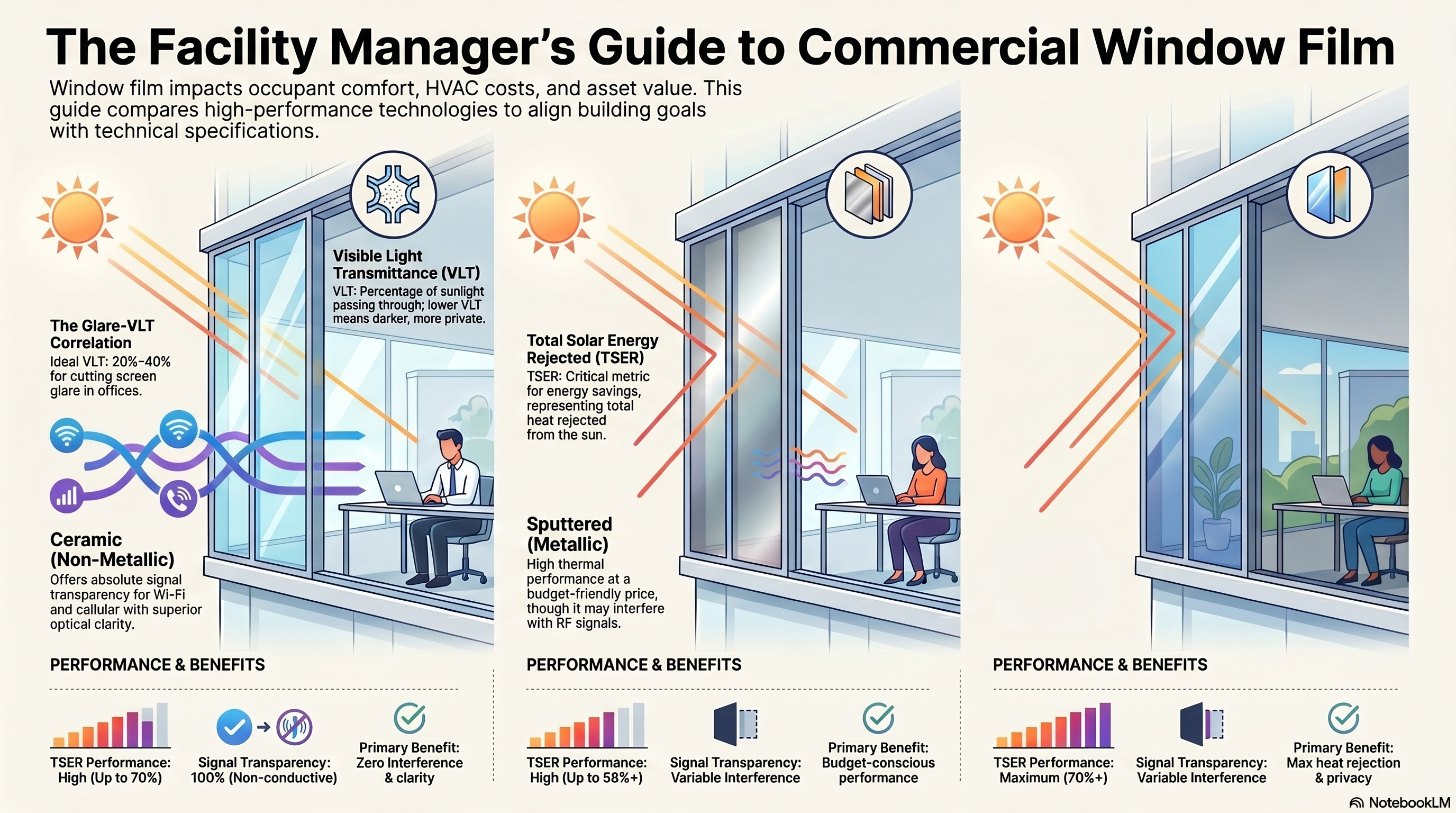
VLT is the percentage of visible sunlight (380-780 nm) that passes through the glazing system after film installation. It is the primary determinant of interior brightness and view clarity. A lower VLT means a darker interior. For offices, balancing VLT with glare control is essential; typical commercial films range from 5% (very dark, high privacy) to 70% (nearly clear).
Total Solar Energy Rejected (TSER)
TSER is the most critical metric for thermal and energy performance. It represents the total percentage of the sun's entire energy (ultraviolet, visible, and near-infrared) that is rejected by the filmed window. This energy is either reflected away or absorbed and re-radiated. A higher TSER directly correlates with reduced heat gain, lower HVAC load (particularly on perimeter zones), and improved occupant thermal comfort. TSER values for high-performance films typically range from 40% to over 70%.
Glare Reduction
While not a single standardized number like VLT or TSER, glare reduction is a function of lowering VLT. A film that reduces VLT from 60% (clear glass) to 20% reduces visible light transmission by two-thirds, dramatically cutting screen and task glare. The quality of the remaining light—its color neutrality—is determined by film technology.
Technology Deep Dive: Sputtered, Ceramic, and Dual-Reflective Films
1. Sputtered (Metallic) Films
Technology: Created in a vacuum chamber using a process called magnetron sputtering, multiple microscopically thin layers of metals (like stainless steel, titanium, or chromium) are deposited onto polyester. This creates a durable, high-performance stack.
Performance Profile: Sputtered films are engineered for maximum solar control. They typically offer the highest TSER for a given VLT among non-reflective films. The metallic layers provide excellent infrared rejection. However, they can impart a slight mirror-like sheen from the exterior and, critically, may interfere with radio frequency (RF) signals, including cellular, GPS, and building wireless systems. This requires careful planning for signal-reliant technologies.
Leading Commercial Brands & Products:
- 3M: The 3M Prestige Series (e.g., PR 70, PR 40, PR 20) represents their top-tier sputtered line. PR 40, for example, offers a 39% VLT while rejecting 58% of total solar energy, with a low exterior reflectivity of 8%.
- Eastman LLumar: The LLumar Vista / Vanceva IR series utilizes sputtered technology. The Vanceva IR 70 film provides 70% VLT with a 50% TSER, showcasing high clarity with significant heat rejection.
- Avery Dennison: Avery's Supra Series employs advanced sputtering for high performance. The Supra 70 film boasts 70% VLT and a 49% TSER.
2. Ceramic (Non-Metallic) Films
Technology: Ceramic films use nano-ceramic particles (typically titanium nitride or other metal oxides) embedded in the film's adhesive or polyester layers. These particles are non-conductive and non-metallic.
Performance Profile: Ceramic technology is defined by its exceptional performance without the drawbacks of metal. It provides very high TSER and superior infrared heat rejection while maintaining 99.9% UV protection. Its key advantages are absolute signal transparency (no RF interference) and superior color stability (no fading or bronzing over time). It also offers the best optical clarity and color neutrality. The trade-off is typically a higher cost per square foot compared to sputtered films of similar performance.
Leading Commercial Brands & Products:
- 3M: The 3M Thinsulate Climate Control Window Film (CCF) series is a ceramic-based product line designed for commercial retrofit. A product like CCF 70 delivers 70% VLT with a 55% TSER and zero metallic content.
- Eastman LLumar: The flagship LLumar IRX and FormulaOne Pinnacle series are premium ceramic films. IRX 15, for instance, provides 15% VLT and a remarkable 70% TSER.
- Avery Dennison: Avery's Nano-Ceramic Series is a direct competitor. Their N-1070 film offers 70% VLT, 50% TSER, and is explicitly marketed for zero interference with communication signals.
3. Dual-Reflective Films
Technology: These films are engineered with a specific reflective coating, often using sputtered metals, to create a higher exterior reflectivity than interior reflectivity. This gives the glass a pronounced mirror-like appearance from the outside during the day.
Performance Profile: Dual-reflective films are the ultimate tool for solar heat gain reduction, often achieving the highest possible TSER (frequently exceeding 65-70%). The high exterior reflectivity is the primary driver of this performance. They also provide exceptional daytime privacy. Considerations include potential issues with bird collisions, light pollution ordinances, and the "black mirror" effect at night when interior lights are on (reversing the privacy benefit). Like sputtered films, they may cause RF interference.
Leading Commercial Brands & Products:
- 3M: The 3M Silver Series and certain 3M Sun Control Window Films (e.g., the 20-20 series) are classic dual-reflective options. A film like 3M's Silver 20 might offer 20% VLT with an exterior reflectivity of 35% and a TSER over 70%.
- Eastman LLumar: The LLumar N-1020 Dual Reflective film is a prime example, providing 20% VLT, 35% exterior reflectivity, and a 71% TSER.
- Avery Dennison: Avery's Dual Reflective Series (e.g., DR-20) is engineered for maximum heat rejection, with DR-20 providing 20% VLT and a 70% TSER.
Specification Matrix for Facility Managers
The following decision framework aligns film technology with common facility management objectives:
- Primary Goal: Maximize Energy Savings & Reduce HVAC Load
- First Choice: Dual-Reflective film (highest TSER).
- Second Choice: High-performance Sputtered film.
- Key Metric: Prioritize the highest TSER within an acceptable VLT range for occupants.
- Primary Goal: Eliminate Glare on Screens & Workspaces
- First Choice: Ceramic film (best clarity at low VLT).
- Second Choice: Sputtered film.
- Key Metric: Target a VLT between 20% and 40% for computer-intensive environments. Ceramic provides the most neutral color at these VLTs.
- Primary Goal: Modern Aesthetics with No Signal Interference
- Only Choice: Ceramic film. Its non-metallic construction guarantees no disruption to Wi-Fi, cellular, DAS, or building automation systems.
- Primary Goal: Daytime Privacy & High Heat Rejection
- First Choice: Dual-Reflective film.
- Consideration: Assess the night-time "reverse privacy" effect and check local glazing reflection codes.
- Primary Goal: Budget-Conscious Performance Upgrade
- First Choice: High-performance Sputtered film. It often provides the best balance of TSER and cost.
Implementation & Best Practices
Specification is only the first step. Proper implementation ensures performance and longevity.
- Professional Installation is Non-Negotiable: Use certified, experienced installers from manufacturer-authorized dealers. Poor installation voids warranties and leads to premature failure.
- Conduct a Glazing Audit: Film performance is dependent on the underlying glass. Identify glass type (annealed, tempered, laminated, insulated units), age, and condition. Consult the film manufacturer for stress and thermal shock risk assessments, especially for large, dark, or south/west-facing panes.
- Demand Comprehensive Warranties: Leading brands offer long-term warranties (often 10-15 years for commercial products) covering fading, discoloration, delamination, and bubbling. Ensure the warranty is transferable to future building owners.
- Pilot Before Full Rollout: Install film on a representative section (e.g., one problematic facade) for 30-90 days. Monitor occupant feedback, temperature differentials, and HVAC performance before committing to a full-building project.
By moving beyond a generic "window tint" specification and leveraging the distinct performance profiles of Sputtered, Ceramic, and Dual-Reflective technologies, facility managers can execute a data-driven window film project that delivers measurable improvements in energy efficiency, occupant comfort, and operational cost control.
Find Commercial Window Tinting Near You
Browse installers by city — get matched with commercial window film specialists in your area.
Technical FAQ
What is the difference between VLT and TSER in window film performance?
VLT (Visible Light Transmittance) measures the percentage of visible sunlight that passes through the filmed window, affecting interior brightness and glare. TSER (Total Solar Energy Rejected) measures the percentage of the sun's total energy (including UV, visible, and infrared) that is rejected, impacting heat gain and HVAC efficiency. While VLT focuses on visible light, TSER addresses overall thermal performance.
How do sputtered metallic films differ from ceramic non-metallic films in terms of performance and application?
Sputtered metallic films use thin layers of metals like stainless steel to achieve high TSER and excellent infrared rejection, but they may interfere with RF signals such as cellular and GPS. Ceramic non-metallic films use nano-ceramic particles to provide high performance without signal interference, offering good TSER and color neutrality. The choice depends on balancing thermal control needs with potential signal disruption in the building environment.
What factors should be considered when selecting a window film for an office building to optimize energy efficiency and occupant comfort?
Key factors include: 1) Desired VLT to balance natural light with glare reduction for screen visibility, 2) High TSER to minimize heat gain and reduce HVAC loads, 3) Film technology (sputtered, ceramic, or dual-reflective) based on performance needs and RF signal considerations, 4) Product specifications from leading brands like 3M, LLumar, and Avery Dennison, and 5) Professional installation and maintenance to ensure long-term effectiveness and warranty compliance.
Ready to optimize your facility?
Review available company information in the directory and prepare a project brief for suppliers.