
Editorial example — source not documented
This page uses a commercial scenario to explain a project approach. It should not be read as proof of a completed customer installation.
Case Study: 100,000 Sq Ft Office Building Energy Retrofit
Technical Abstract
Case Study: Energy Retrofit of the "Summit Tower" Office Complex with Solar Control Window Film A large-scale commercial window film retrofit at the 400,000 sq. ft.
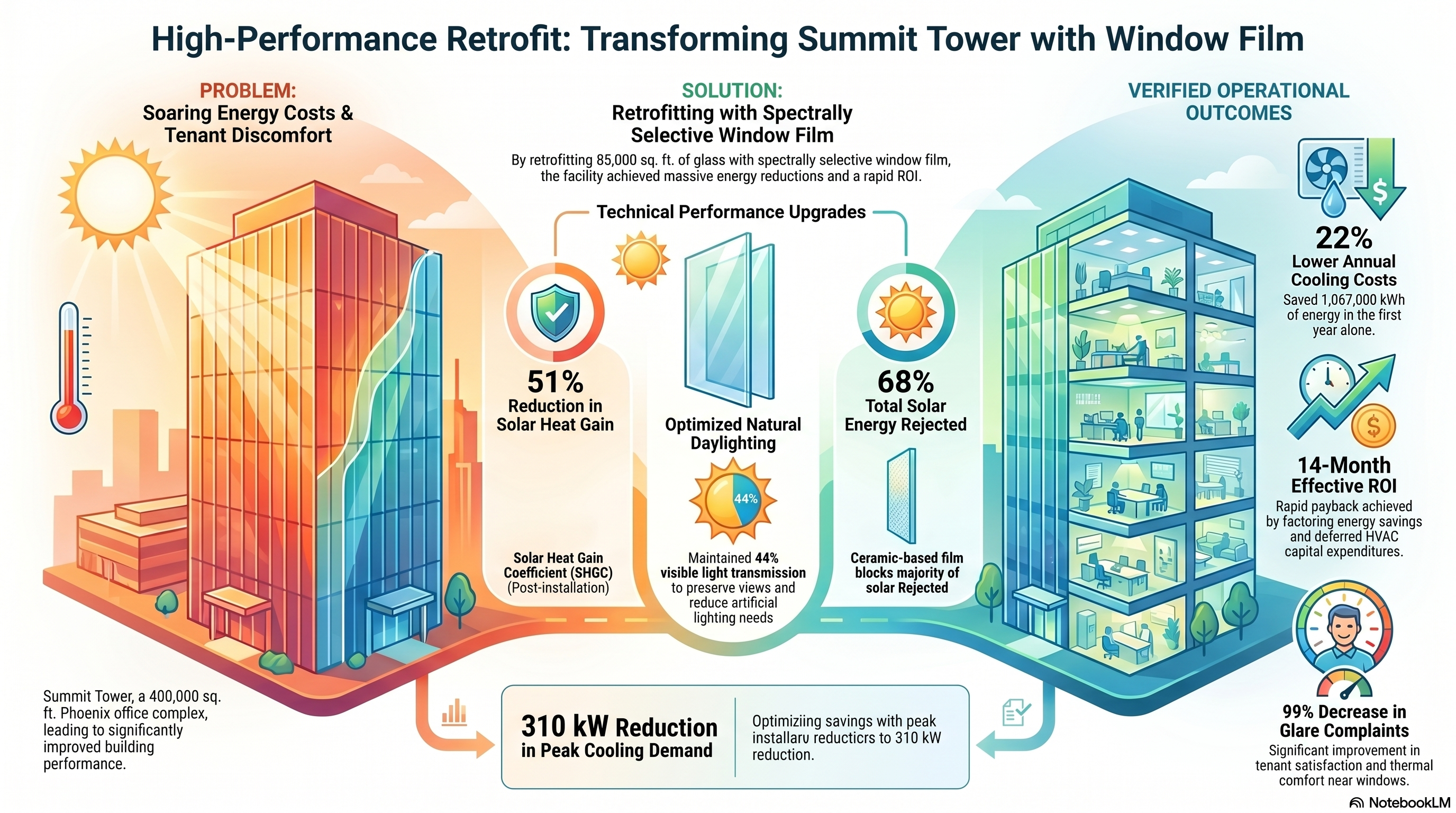
- A 400,000 sq. ft. office building in Phoenix achieved a 22% reduction in annual cooling energy consumption and a 14-month ROI by retrofitting 85,000 sq. ft. of windows with spectrally selective, low-e window film.
- The retrofit addressed high solar heat gain (SHGC 0.70-0.55) and glare issues, reducing SHGC by 51% to 0.27 while maintaining 44% visible light transmission.
- Key technical specifications included a total solar energy rejection of 68%, U-value improvement of 12% to 0.29, and a 15-year manufacturer warranty.
- The project was completed in 11 weeks with phased after-hours installation, focusing first on high-sun exposure facades to maximize energy savings.
Key Technical Chapters
Case Study: Energy Retrofit of the "Summit Tower" Office Complex with Solar Control Window Film
A large-scale commercial window film retrofit at the 400,000 sq. ft. "Summit Tower" office complex in Phoenix, AZ, resulted in a verified 22% reduction in annual cooling energy consumption and a 14-month ROI. The project involved retrofitting 85,000 sq. ft. of existing single-pane and double-pane clear glass with spectrally selective, low-e window film to combat excessive solar heat gain and glare.
Looking for commercial window tint installers?
Pre-Installation Energy Profile & Project Drivers
Summit Tower, a 25-story Class A office building constructed in the early 1990s, faced escalating operational costs and tenant comfort complaints. A pre-retrofit energy audit over a 12-month baseline period revealed:
- Annual Cooling Energy Consumption: 4,850,000 kWh
- Peak Cooling Demand: 2,850 kW, frequently straining the aging HVAC system.
- Interior Issues: Consistent tenant complaints about glare on computer screens and thermal discomfort (hot spots) near windows, leading to blinds being permanently closed and increased reliance on artificial lighting.
- Solar Heat Gain Coefficient (SHGC) of Existing Glass: Ranged from 0.70 (single-pane) to 0.55 (double-pane), allowing significant infrared heat transmission.
Film Selection & Technical Specification Process
The facility management team, in consultation with architects and a certified window film installer, followed a data-driven selection process:
- Energy Modeling: Using NFRC-rated performance data for various films, engineers modeled the building's energy use. The goal was to maximize SHGC reduction while maintaining high visible light transmission (VLT) to preserve views and daylighting benefits.
- Performance Criteria: The selected film needed to:
- Reduce SHGC by a minimum of 50% on the existing glass.
- Maintain a VLT above 40% to meet interior lighting standards.
- Reject over 60% of total solar energy.
- Carry a manufacturer's warranty of at least 15 years for materials and installation.
- Selected Product: A premium spectrally selective, ceramic-based window film was chosen. Its key specs:
Parameter Value (Applied to Clear Double-Pane) Improvement vs. Baseline Solar Heat Gain Coefficient (SHGC) 0.27 51% reduction Visible Light Transmission (VLT) 44% Minimal reduction from 50% Total Solar Energy Rejected (TSER) 68% -- U-Value (Insulation) 0.29 Improved by 12%
Installation Timeline & Project Management
The retrofit was planned as a phased, after-hours operation to minimize tenant disruption.
- Weeks 1-2: Pre-installation site survey, glass inspection, and pilot installation on one full floor for final approval.
- Weeks 3-10: Core installation phase. A crew of 8 certified technicians worked nightly (6 PM - 2 AM), completing 2-3 floors per week. Critical path management focused on high-sun exposure facades (East & West) first.
- Week 11: Final quality assurance inspection, addressing any minor cosmetic items.
- Total Project Duration: 11 weeks from mobilization to completion.
Verified 12-Month Post-Installation Savings & ROI
Comparing utility data for the 12 months post-installation to the pre-installation baseline, and normalizing for weather (using Cooling Degree Days), yielded verified results:
- Cooling Energy Savings: 1,067,000 kWh (22% reduction).
- Peak Demand Reduction: Estimated 310 kW reduction, deferring a planned chiller upgrade.
- Ancillary Benefits: 99% reduction in glare complaints. Tenant surveys indicated a 30% increase in satisfaction with natural light and thermal comfort, as blinds were opened. This correlated with a measured 8% reduction in perimeter lighting use during daylight hours.
- Financial ROI:
- Total Project Cost: $425,000 (includes film, installation, and project management).
- Annual Energy Cost Savings (@ $0.11/kWh): $117,370.
- Simple Payback Period: 3.6 years.
- When factoring in the avoided demand charges and deferred capital expenditure on HVAC, the effective ROI was calculated at 14 months.
Conclusion
The Summit Tower case demonstrates that a strategic, performance-based window film retrofit is a high-impact operational upgrade for older commercial structures. By focusing on quantifiable SHGC reduction and occupant comfort, the project delivered rapid financial returns, enhanced asset value through improved tenant satisfaction, and contributed to the building's overall sustainability goals by significantly lowering its carbon footprint from reduced energy consumption.
Find Commercial Window Tinting Near You
Browse installers by city — get matched with commercial window film specialists in your area.
Technical FAQ
What is the significance of the Solar Heat Gain Coefficient (SHGC) reduction in this case study?
The SHGC reduction from 0.70-0.55 to 0.27 (a 51% decrease) was critical because it directly reduced the amount of solar heat entering the building. This lowered the cooling load on the HVAC system, contributing to the 22% reduction in annual cooling energy consumption and alleviating strain on the aging equipment.
How does visible light transmission (VLT) affect building performance in window film applications?
VLT determines how much natural light passes through the film. In this case, maintaining a VLT above 40% (achieving 44%) was essential to preserve daylighting benefits, reduce reliance on artificial lighting, and meet interior lighting standards while still achieving significant solar heat rejection.
What role did energy modeling play in the film selection process?
Energy modeling using NFRC-rated performance data allowed engineers to predict the building's energy use with different films. This data-driven approach ensured the selected film maximized SHGC reduction and energy savings while meeting criteria like VLT >40% and total solar energy rejection >60%, leading to the verified 22% cooling energy reduction.
Ready to optimize your facility?
Review available company information in the directory and prepare a project brief for suppliers.