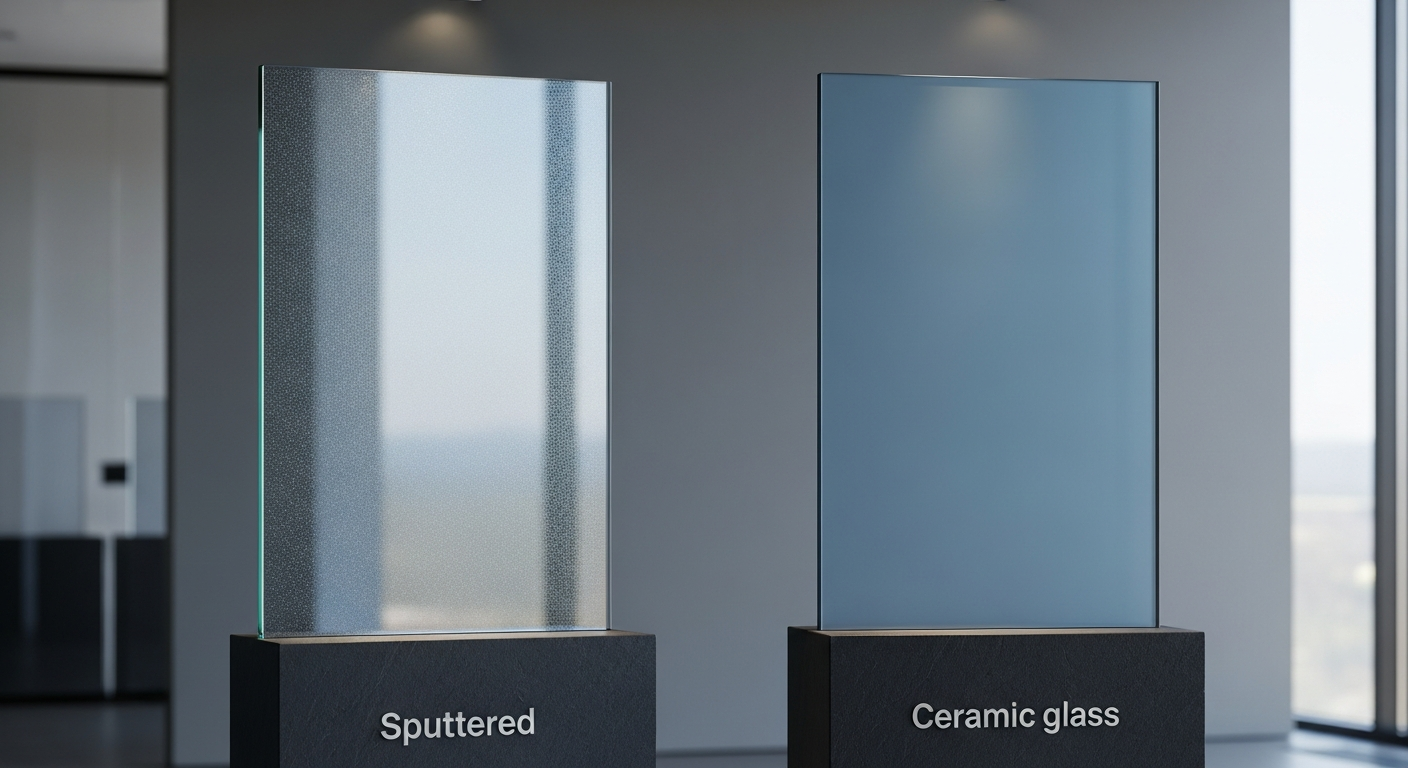
Editorial / technical guide
This page is educational content, not a documented customer project.
Sputtered vs. Ceramic Window Film: Performance analysis for High-Rise Assets
Technical Abstract
For facility managers and architects overseeing high-rise commercial assets, the selection of window film is a critical engineering choice. This guide provides a deep technical comparison between Sputtered (Metallic) and Nano-Ceramic films, focusing on TSER, RF signal transparency, and long-term durability in coastal environments.
- Sputtered films provide higher absolute heat rejection but act as a Faraday cage, blocking 5G/RF signals.
- Ceramic films offer high heat rejection with low reflectivity, preserving the architectural intent of clear glass.
- Metallic films are prone to edge corrosion in coastal zones; Ceramic films are inorganic and inert.
- Ceramic technology allows for higher VLT (more natural light) while maintaining professional-grade IR rejection.
Key Technical Chapters
Introduction to Advanced Thin-Film Technology
For facility managers and architects overseeing high-rise commercial assets, the selection of window film is no longer a cosmetic decision but a critical engineering choice. As building envelopes become more transparent, the thermal load on HVAC systems increases exponentially. Two primary technologies dominate the high-performance market: Sputtered (Metallic) and Nano-Ceramic films. Understanding the molecular differences between these two is essential for optimizing Total Solar Energy Rejection (TSER) while maintaining structural and functional integrity.
Looking for commercial window tint installers?
Sputtered Films: The Physics of Metal Deposition
Sputtered films are manufactured using a process called vacuum deposition. In a vacuum chamber, atomic layers of metals—such as silver, nickel-chromium, bronze, or titanium—are 'sputtered' onto a polyester base. This creates a highly uniform, dense metallic layer that is exceptionally efficient at reflecting solar radiation.
Performance Characteristics of Sputtered Films:
- High TSER: Because they rely on reflection rather than absorption, sputtered films often achieve TSER ratings of 70% to 80%, making them ideal for west-facing elevations in extreme climates.
- Durability: The sputtering process creates a strong bond that resists delamination better than traditional dyed or laminated films.
- Visual Aesthetics: Sputtered films typically have a reflective or 'mirrored' appearance, which can be desirable for uniformity in older glass structures but may conflict with modern 'clear glass' architectural trends.
Nano-Ceramic Films: The Science of Selective Absorption
Ceramic films utilize advanced nanotechnology to embed microscopic particles of Indium Tin Oxide (ITO) or Antimony Tin Oxide (ATO) into the film. Unlike metals, these ceramic particles are spectrally selective—they are engineered to allow the majority of visible light to pass through while aggressively absorbing or reflecting Infrared (IR) and Ultraviolet (UV) radiation.
Performance Characteristics of Ceramic Films:
- Spectral Selectivity: Ceramic films can achieve a Visible Light Transmission (VLT) of over 70% while still rejecting more than 50% of the total solar heat, providing a 'clear' look with high thermal protection.
- Low Reflectivity: Interior and exterior reflectivity is often lower than the glass itself, preserving the building's original design and views.
- Non-Conductive: Being inorganic and non-metallic, ceramics do not interfere with modern telecommunications.
Critical Comparison Factors for Commercial Assets
1. RF Signal Interference (The Connectivity Problem)
In the age of 5G and high-density office environments, signal transparency is a non-negotiable requirement. Sputtered films, due to their metallic composition, act as a Faraday cage, significantly attenuating RF signals. This can lead to 'dead zones' in executive suites and force building owners to invest in expensive distributed antenna systems (DAS). Nano-ceramic films are signal-neutral, ensuring zero interference with mobile devices, Wi-Fi, and emergency services frequencies.
2. Coastal Corrosion and Oxidation
For high-rise assets located in coastal environments (within 5km of salt water), sputtered films—particularly those utilizing silver—are susceptible to edge corrosion. Over time, salt and moisture can penetrate the film's edge, causing the metal to oxidize and create a 'fingering' effect or discoloration. Ceramic films are chemically inert and inorganic; they cannot rust or corrode, making them the superior choice for marine-exposed commercial property.
3. Visible Light Transmission (VLT) vs. TSER
Architects often face a trade-off: heat rejection vs. natural light. Sputtered films generally require a lower VLT (darker/more reflective) to achieve high heat rejection. Ceramic films break this correlation. A high-end ceramic film can provide the same heat rejection as a mid-grade sputtered film while allowing 20% to 30% more natural light into the floor plate, reducing the need for artificial lighting and improving tenant well-being.
Final Engineering Recommendation
While sputtered films offer the highest absolute heat rejection at a lower price point, they are best suited for industrial or suburban assets where signal interference and coastal corrosion are secondary concerns. For Grade-A CBD high-rises, especially those with high-tech tenants and coastal exposure, Nano-Ceramic technology is the professional standard for long-term ROI and operational performance.
Find Commercial Window Tinting Near You
Browse installers by city — get matched with commercial window film specialists in your area.
Technical FAQ
Will ceramic window film interfere with my building's 5G reception?
No. Unlike sputtered metallic films, nano-ceramic films are non-conductive and do not interfere with cell signals, Wi-Fi, or radio frequencies.
Which film type is better for a building within 2 miles of the ocean?
Nano-ceramic films are recommended for coastal areas because they do not contain metals that can oxidize or corrode when exposed to salt air.
Can I achieve 70% heat rejection with a clear-looking film?
While 'Total Solar Energy Rejection' (TSER) usually ranges from 40-60% for clear films, nano-ceramics can reject up to 90% of Infrared heat, which constitutes the majority of the solar heat felt by occupants.
Ready to optimize your facility?
Review available company information in the directory and prepare a project brief for suppliers.